Saturday, September 12, 2020

Sointula weather

After a summer of very high temperatures and humidity, the weather in New York is turning toward autumn: 62 degrees this morning! As I sit here typing, it is almost like a Sointula morning. When I would wake up in Sointula during the summer months, I immediately put on a long-sleeved shirt and my warm long pants, along with socks. The temps were generally in the 50s, going up by August to 70 during the day. How I have missed that weather this summer, and I was reminded anew of it the other day when there was an email from Heather saying she had just come in from working in the yard and that the weather was "fabulous." I know exactly what she meant, and hope to enjoy it again next summer.


Still, I made the best of the hot weather and spent time on the Hudson River kayaking. Tomorrow I am going on a paddle to the State of Liberty. We won't actually land on Liberty Island, but will circumnavigate it. In the meantime, a photo of a recent outing. (Click on photo to enlarge.) That is New Jersey in the background, not Manhattan. Another outing in hot weather was a trip to the Jersey shore. The other photo is of my friend Nona on that outing. I was sitting on a beach chair under an umbrella, like those sensible folks on the right-hand side of the photo.


Saturday, August 22, 2020

New York in mid-pandemic

I can't remember now when the heat wave began, but I was running my air conditioner most days and wishing that I were in Sointula this summer. This past weekend there was some respite, and I was able to open the windows. But today again it was hot and humid. Walk a block and you feel you are going to expire. But we will make it, right? That is the New York City spirit, always congratulating itself. In the days when it was cool, I walked around and took some pictures. (As always, click to view larger.)

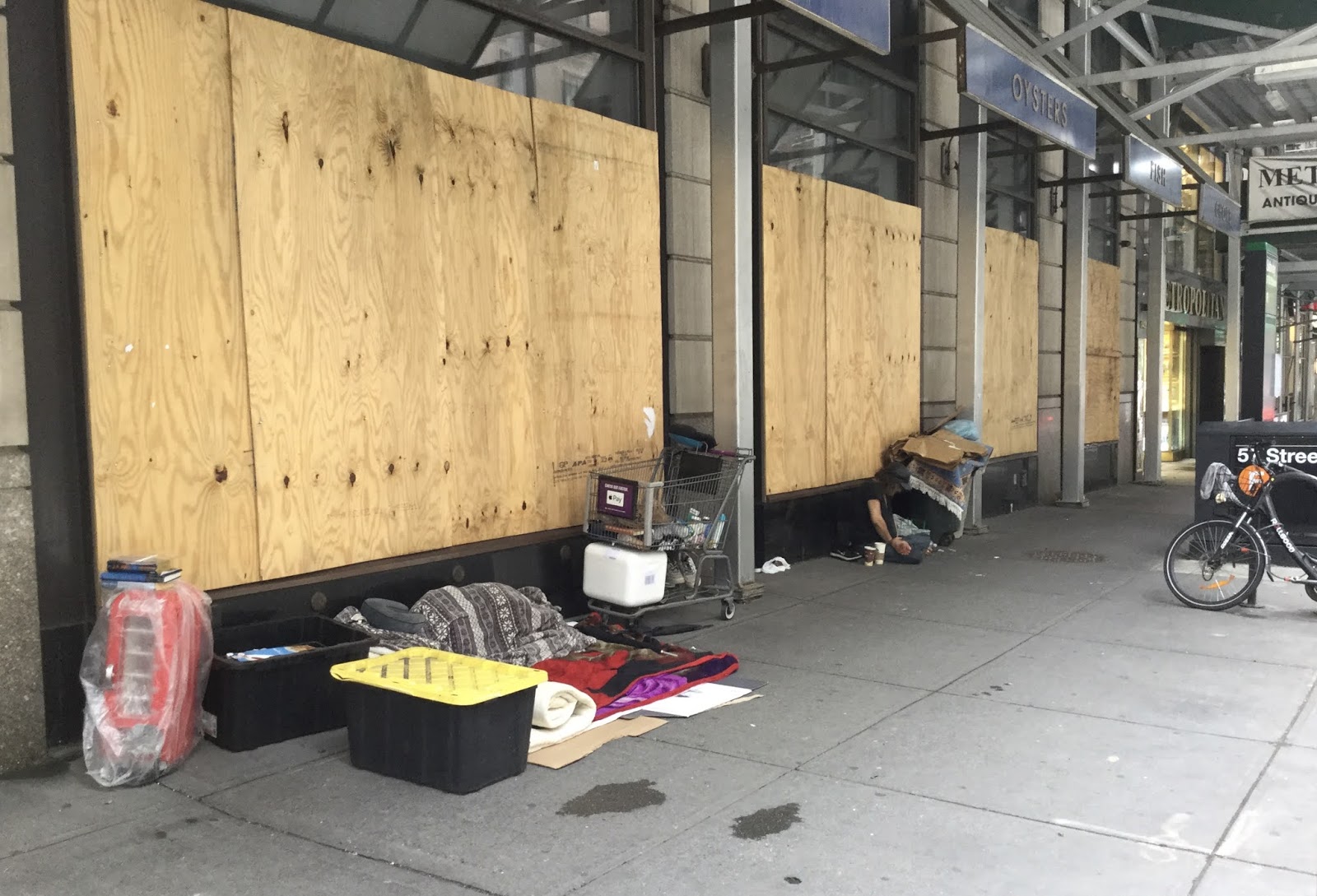
In the first month or so of the pandemic, there was little car traffic. People laughed that you didn't have to look both ways when crossing the streets. No more. Vehicular traffic is back with a vengeance. Oddly, this presence does not align with people on the streets. The photo above of Sixth Avenue, shows what I mean. The avenue is a canyon of office buildings, and on any weekday the sidewalks would be packed. But the offices are now empty, and likewise the sidewalks. In the place of office workers, homeless folks set up their lodging next to stores that have gone out of business.


The big street activity is outdoor "dining." Here follow a few pictures from my neighborhood on the Upper West Side.


And, naturally, half the world is on a cell phones even a homeless gal.


Saturday, August 8, 2020

The limits of civilization

World Trade Center 2020
 Two nights ago there was an electricity outage on the Upper West Side, which is where I live. From the short account in the newspaper, it seems to have been rather limited as these things go. In Sointula over the years I experienced several blackouts, one, as I remember, caused by some natural occurrence (a tree took out a power line?) on Vancouver Island, which likewise affected Malcolm Island. Looking back on those blackouts in Sointula, I don't recall being very disturbed or even inconvenienced, beyond being unable to read by candlelight.

When such an outage occurs in a big city, however, the effect is much different, although the time of day makes a difference. For instance, January 6, 2019 -- I later made note of the details in my diary -- happened to be the coldest day of the winter season thus far. It was on that cold day that, at 9 p.m., the electricity went out of my side of the West 87th Street. Across the street, my neighbors' apartment buildings were still lit up. I suspect that our bad luck had to do with the massive amount of road repair that was going on during those months on my street and others on the Upper West Side. Shortly after the lights went out, my cell phone rang -- that little flip phone that I own solely because I need it in Sointula -- and my neighbor Elaine (mentioned in previous post) was on the line, inviting me to come over and sit before the fireplace with her and her son Kieran. Which I promptly did. They had plenty of wood, and we sat until midnight, til every last stick of wood had been burnt, and drank wine and talked. It was a particularly good occasion. Elaine, too, is a widow, and I had known her husband, Peter, long before I knew Elaine, the way you know people who live on your street. Her son Kieran was with us, and he liked hearing my memories of Peter, since Kieran was only six years old when his father died. When I went home at midnight, there was still enough hot water in the pipes that I was able to fill a water bottle for bed. By daylight the power was back.

Upper West Side roadwork
Flash forward to power outage of August 2020. This one, according to the news item, took place around 5 a.m. In other words, I was in bed and asleep. Suddenly, I woke up. It was as if the lack of noise in my apartment -- the ceiling fans no longer rotating, the air conditioner off -- roused me from my sleep. It took only an instant for me to register what the lack of noise meant, and I was on my feet. Normally, in the middle of the night, when I go to the bathroom or get up for some water -- there is plenty of light. My apartment faces the street and my windows are very high, so that the lights of the buildings across the street, whether in apartments or from outdoor sources, send enough light into my apartment that I can make my way comfortably in the dark to the bathroom. On this occasion, however, it was dark, dark in my rooms and likewise across the street. I walked to the windows in the living room and looked out. It was very eerie, and it struck me forcibly how vulnerable a city is, dependent as it is on an immense infrastructure to "power" it. Powering, not only in the sense of electricity and water and fuel, but also its people, who are dependent on that infrastructure to go about their daily business. Although I have none of the skills of my Sointula friends -- fishing, farming, even growing herbs -- I did not feel endangered by the blackouts there. Unconsciously, I must have felt that the people of Malcolm Island would have come together to help one another in the event of a long period without electricity.

New York City is a different matter. Imagine the effect on me and my fellow New Yorkers had this blackout continued beyond half an hour. The heatwave is for the moment behind us -- yesterday I finally was able to open the windows and have fresh, almost cool air -- but the temperature of many people still runs high. I fear for what might have happened had it continued.


Friday, August 7, 2020

Sointula on my mind

The title of this post gives voice to what is going on with me in the fifth month of the pandemic. Instead of being in Sointula this summer, enjoying afternoon temperatures of 70 degrees, I am here in virus central, New York City, during an extended heat wave. It might be said that the lockdown has actually provided the conditions that attracted me every summer to Sointula: a place to work without the distractions that invariably exist in a big city. Indeed, the first two months were truly empty of distractions. When the extent of the hospital and medical overload in New York City became evident, it was easy to resist going outside. How wonderfully quiet the streets were! The constant sound of car horns was history, as well as construction noise. On the downside, the parks were packed, and New Yorkers are poor at social distancing, which was particularly irritating for me, since I do not wear a mask in public -- only in enclosed spaces, like stores and, now, the subways and busses -- and I had to put with dirty looks from people who think you can catch the virus from six feet away. I tried to turn my park-walking experience into a simulacrum of the Thursday morning rambles in Sointula: instead of following the paths, I would stomp through the more overgrown and also hilly parts of Riverside Park.

By the third month, noise was on the rise. Riverside Park abuts on the West Side Highway, with the traffic heading upstate and across the Hudson River to New Jersey returning to pre-lockdown levels. Mask-wearing also began to fall off, by which time I had started hooking a mask to my ears, but slung below my chin, when out in public. I wanted to give the impression, after all, that I was not ignoring the wisdom of the herd. Mask-wearing has come back with a vengeance lately on the Upper West Side -- even when people are driving their own cars! I trace the day when people who otherwise would not dream of voting for Donald Trump started wearing masks full time to the day the president recommended that people wear them in public. Go figure.

The heat wave that started about 20 days ago curtailed by daily walks, but, to compensate, I joined the Manhattan Kayak Company and have been doing some kayak tours and standup paddleboarding on the Hudson River. The past few days we are having a respite. Today, my windows are open!

While I truly miss the companionship of my friends in Sointula, I have been fortunate during the lockdown to have become better friends with several neighbors. One is Elaine, who lives two doors down and who has a small backyard. I am often welcomed there for a barbecue. That's me in the green jacket in the photo at the top, and Elaine in the flowered pants in the bottom photo.

I continue to go out shopping every day -- wearing a mask when inside a store, of course. I have eaten out a few times, in the new arrangement of outdoor (i.e., on the street) cafes, but have more or less got used to my own cooking and have had the pleasure of saving some money. It will go into my fund for Sointula 2021!

More New York news in the next post.

Friday, August 16, 2019

The Mateoja Heritage Trail


Thursday morning is hiking day, as a group of residents meets at the Fire House and travels to a trailhead on the island. Yesterday because it was low tide, I walked with another adventurous visitor, Constance from Vancouver, along the shoreline at Rough Bay all the way to the youth hostel, a very secluded, out of the way place. I say "adventurous," because, as the above picture shows, the path is one of stones.

One of the better known trails in Sointula is the Mateoja Heritage Trail, apparently named for one of the early Finnish settlers of the island. The start of the trail is right near where I live, as can be seen on the map here. (As always, click to enlarge.) Herewith a few photos of my two hikes along the trail this season. At the end of the trail is "Big Lake," which appears to be a popular swimming hole, with comfortable temperatures (unlike that of the waters surrounding the island).


Friday, August 9, 2019

The Beautiful in Nature

Thea and Yours Truly at Shiels Bay
We went out to Bere Point to kayak this week. We were on the ocean surrounded by fog and kelp beds. Tammy kept saying how "beautiful" it all was. What was it she found beautiful? There was nothing to see. Okay.  It was an aesthetic response. She was expressing a mood. She was touched.


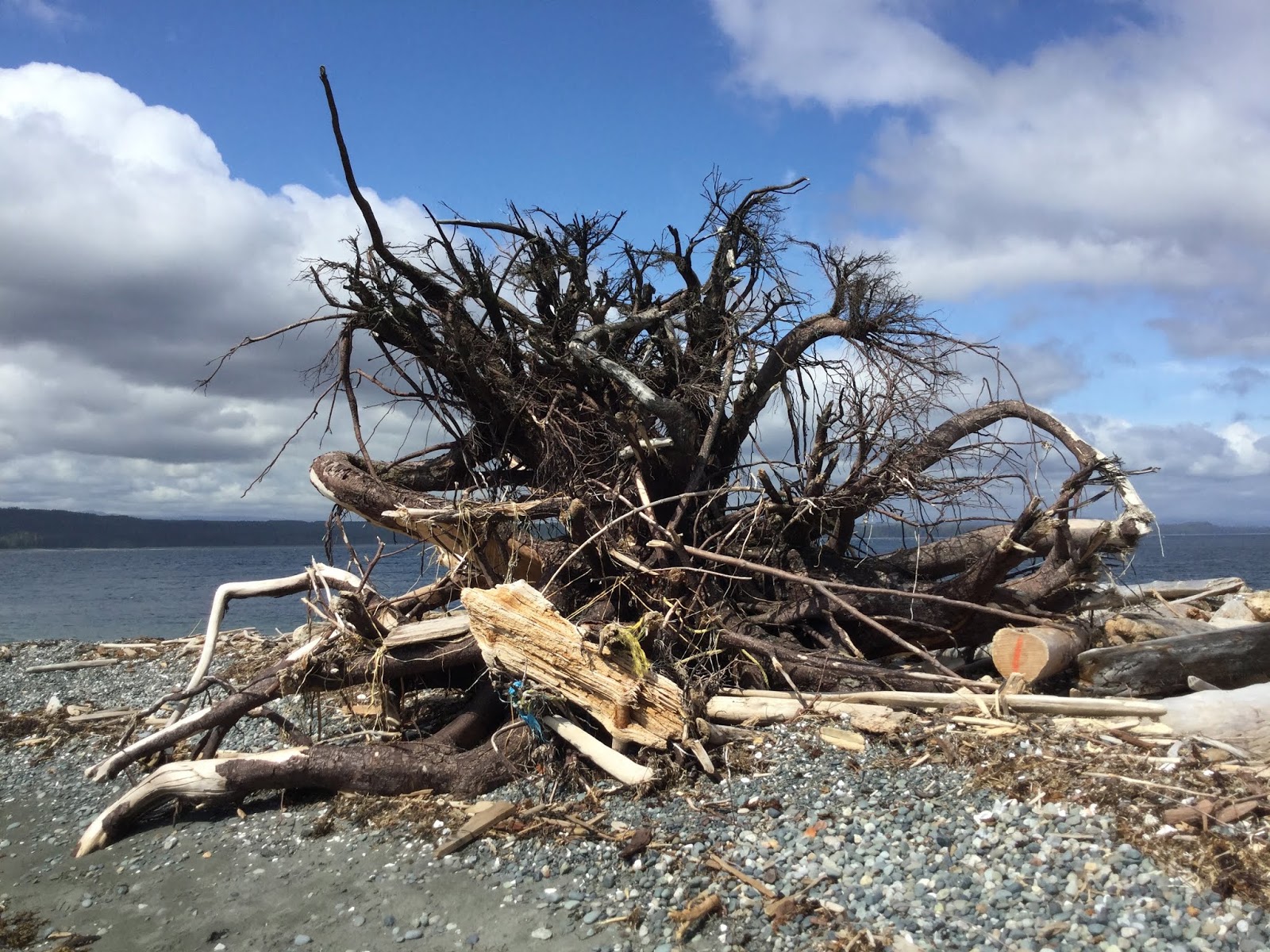
Yesterday Linda, Thea, and I hiked to Shiels Bay. I found myself stopping constantly to examine certain natural forms, in particular those of driftwood, and was astonished, amazed, pleased, and so on. Again, it was an aesthetic response. In both cases, we expect other people to be similarly moved. Beautiful, ain't it? (Click photos to enlarge.)


The odd thing about "Beauty" in nature is how different each particular instance is and how difficult it would be to bring a number of objects under a single denominator. In a painting or in any work of art we have criteria by which we evaluate its merits, even if we agree that humans respond differently to a work. These driftwood formations defy any attempt to analyze them. They are not governed by an artist's intention. They are purposeless, having come to be what they are without any intent. And next year will look totally different, or may not exist at all.

Friday, July 26, 2019

Thursday, July 4, 2019

Canada Day

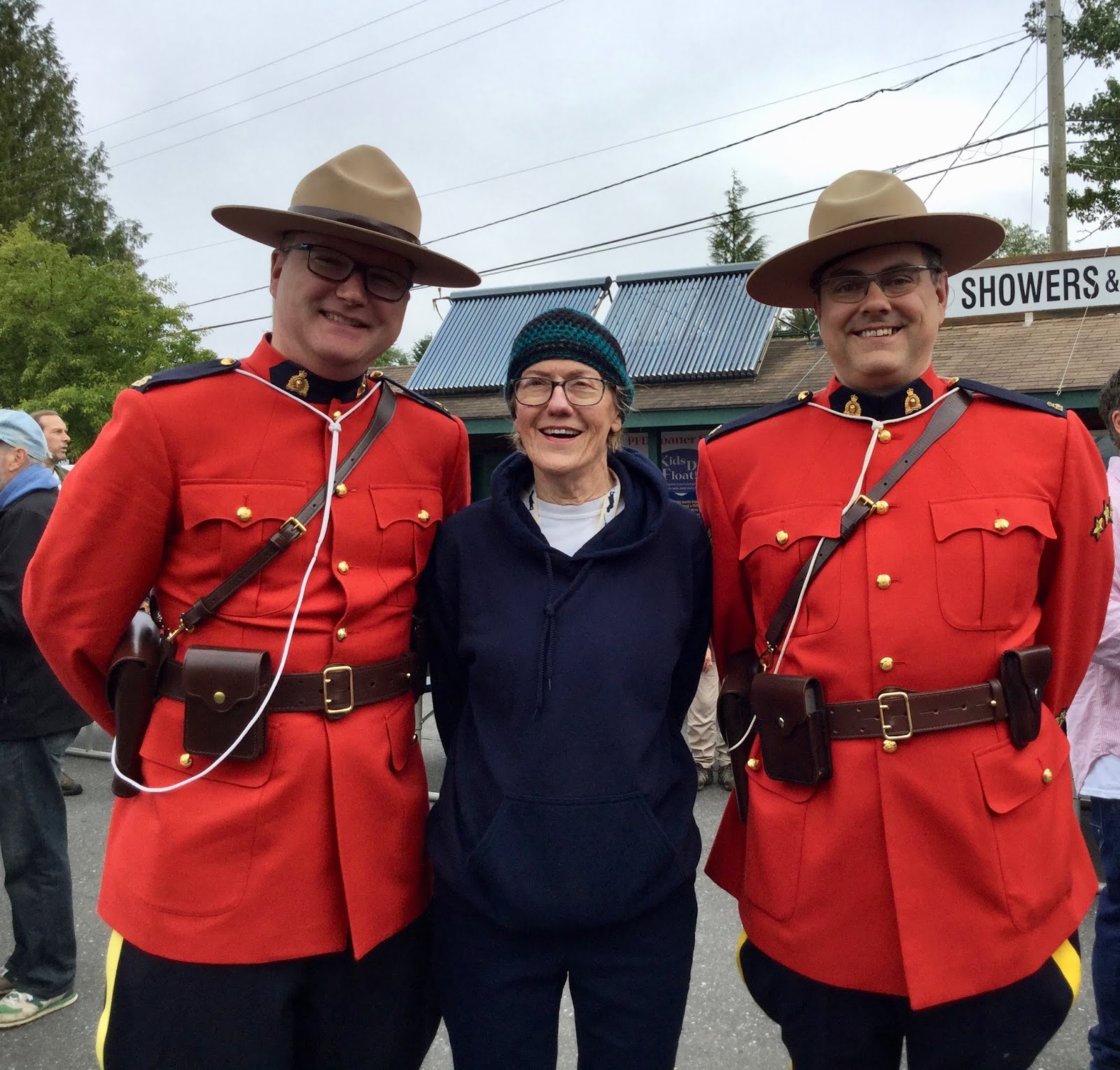
I am writing this on the Fourth of July, but as I am in Canada I will not be partaking in any U.S. festivities, including the annual barbecue at my neighbor Elaine's on West 87th Street. July 1 was Canada's national day, commemorating the anniversary of the Constitution Act of 1867, which was celebrated with various activities in Sointula, starting with a parade and a pancake breakfast at the marina. People were outfitted festively in red-and-white, and on all such occasions there is always the appearance of "Mounties" in full regalia. Herewith a few photos from the day. It was a sea of red and white.

One event at the marina was a contest.of Canada "trivia" matching two teams As I discovered there are many differences in Canada's constitution (both upper and lower case) from the U.S.

The singing of the national anthem, "O Canada"

Annual picture of Yours Truly with Mounties
Tina and Candace

Alden and lovely wife
Janine and Faith

Monday, July 1, 2019

Return to Sointula

I returned for my summer sojourn two weeks ago already, and it has been filled with lots of good work on my novel: I accomplish more in three hours of a morning than in several days in Manhattan. You cannot buy the quiet that I enjoy on this island. As I sit writing this, it is July 1, Canada Day. There were celebrations today down at the harbor, of which I will post pictures later, including my annual photo of myself with Mounties. (Click on photos to enlarge.)

Walk on the beach near the lighthouse
Herewith, however, a few pictures from early days here, which included a walk to the lighthouse with the Thursday morning hikers. And also my workspace in the kitchen; I have another desk in the living room. The temperature here in the mornings hovers around 55 degrees F; thus, the mittens drying on the window ledge. There has also been a new resident at the Art Shed, Liz Toohey-Wiese, whose recent paintings have as their subject the forest fires that ravage so much of British Columbia every summer.


Zeballos wildfire
Liz Toohey-Wiese in Art Shed studio

Saturday, November 24, 2018

Another island

I spent Thanksgiving on Long Island, much larger than Malcolm Island. Another difference concerns beaches. In Westhampton, the beach is sandy, and you see your footprints as you walk, along with the prints of dogs and of birds. On Malcolm Island, it is all rocks, very polished rocks, not so easy to walk on, and certainly no prints of man or dog. In contrast, Malcolm Island has the most wonderful varieties of driftwood, while the beaches of Westhampton display scarcely a stick. (Click on photos to enlarge.)


Man and dog were here


But as on Malcolm Island, I notice that I am always looking at the beach in front of my feet when I walk, as if I might discover a lovely shell or an interesting rock formation. Again, on Malcolm Island, the beach itself, being so rocky, one seldom comes across a shell that is not broken. But why is it that we stop to gather rocks and shells anyway? On city streets, after all, who bothers examining gum labels, plastic dental picks, or other debris? The former suggest natural processes, from which we humans are removed. The latter is an unattractive reminder of waste and of disregard for the natural world.
I also have to add that I love the solitariness of winter beaches, as in Westhampton. There were a few people out walking, especially with their dogs, but a winter beach does not invite conviviality. It is a place to reflect, again, perhaps on the transience of life as represented  by our footprints in the sand, soon to be effaced by the next wave.

The objects on the beaches, on the other hand, represent processes that have been going on from time immemorial and will continue after we are no longer here. The world today is exactly as it was when such objects came into formation, especially in the case of rocks, which testify to the age of the earth. While I was in Westhampton, I was reading Autumn, a volume in Karl Ove Knausgaard's new literary quartet. I came across a passage that speaks to this special character of rocks and shells. Knausgaard, writing of frogs, has this to say:

"Like all other amphibians there was something primordial about [frogs], they came from a different time than us, from a world that was simpler, for even trees and plants were more primitive then, and that they were still here, unlike nearly all other creatures that had existed at that time, was due to the fact that their way of life was so resilient and unaffected by all the changes the surrounding world had undergone. To them the world now must appear the exact same as the world then: they saw, did, thought and felt the same, and this changelessness, in which neither the past nor the future existed, was in principle no different from that possessed by more recent species, like squirrels or badgers, except that it had lasted immeasurably longer."


Thursday, October 11, 2018

Two more Sointula 2018 memories

I am posting here two pictures from my summer stay. One of them is of my friend Heather and myself, posing with a copy of the London Review of Books, a picture of us that was taken in connection with a competition held by the LRB showing people reading the publication. The other picture is of myself at the Salmon Days parade. More next year! (Although I may post on utopias in the coming months.)