Friday, July 26, 2019
Thursday, July 4, 2019
Canada Day
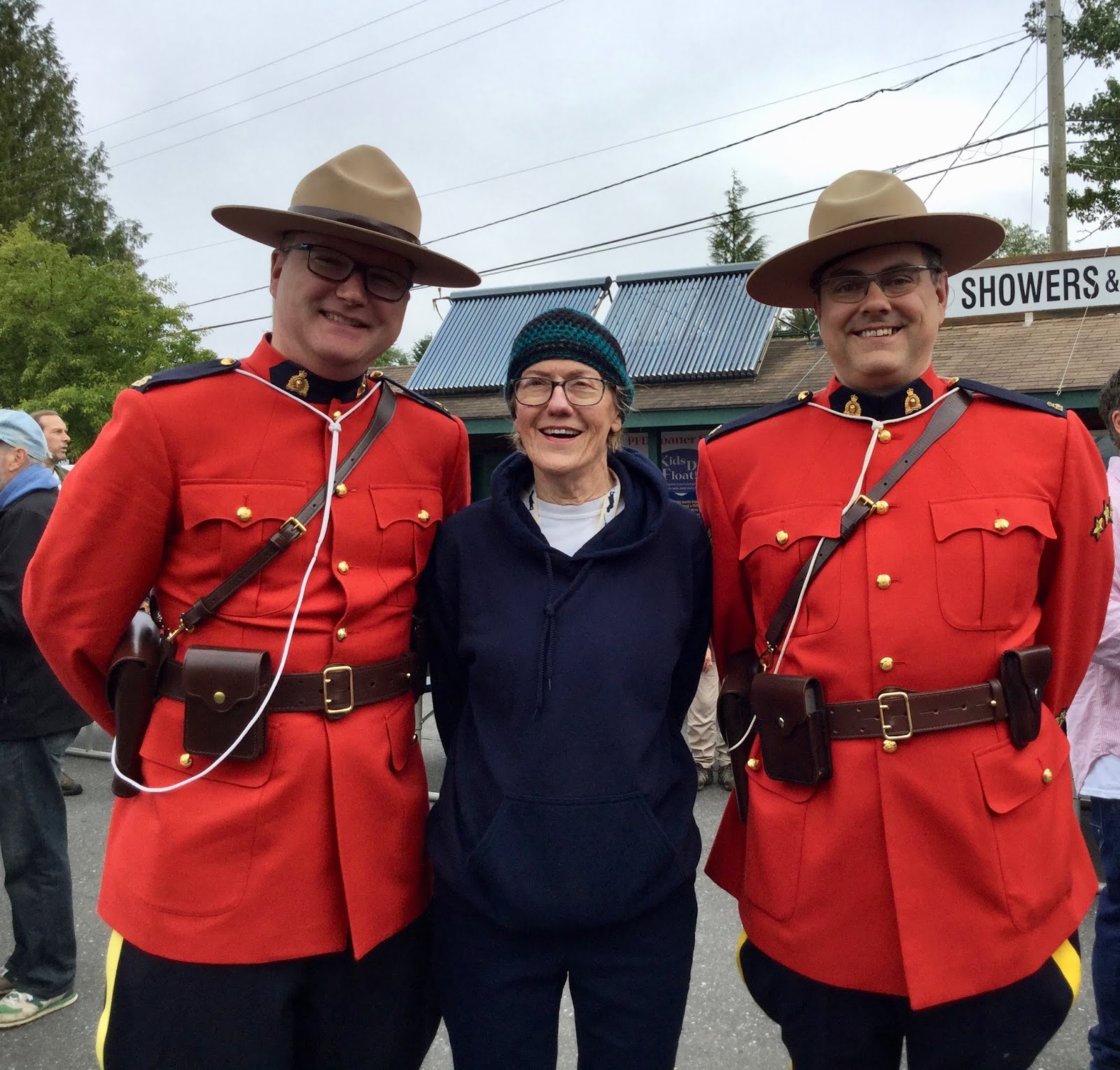
I am writing this on the Fourth of July, but as I am in Canada I will not be partaking in any U.S. festivities, including the annual barbecue at my neighbor Elaine's on West 87th Street. July 1 was Canada's national day, commemorating the anniversary of the Constitution Act of 1867, which was celebrated with various activities in Sointula, starting with a parade and a pancake breakfast at the marina. People were outfitted festively in red-and-white, and on all such occasions there is always the appearance of "Mounties" in full regalia. Herewith a few photos from the day. It was a sea of red and white.
One event at the marina was a contest.of Canada "trivia" matching two teams As I discovered there are many differences in Canada's constitution (both upper and lower case) from the U.S.
![]() | ||
| The singing of the national anthem, "O Canada" |
![]() |
| Annual picture of Yours Truly with Mounties |
![]() |
| Tina and Candace |
![]() |
| Alden and lovely wife |
![]() |
| Janine and Faith |
Monday, July 1, 2019
Return to Sointula
I returned for my summer sojourn two weeks ago already, and it has been filled with lots of good work on my novel: I accomplish more in three hours of a morning than in several days in Manhattan. You cannot buy the quiet that I enjoy on this island. As I sit writing this, it is July 1, Canada Day. There were celebrations today down at the harbor, of which I will post pictures later, including my annual photo of myself with Mounties. (Click on photos to enlarge.)
Herewith, however, a few pictures from early days here, which included a walk to the lighthouse with the Thursday morning hikers. And also my workspace in the kitchen; I have another desk in the living room. The temperature here in the mornings hovers around 55 degrees F; thus, the mittens drying on the window ledge. There has also been a new resident at the Art Shed, Liz Toohey-Wiese, whose recent paintings have as their subject the forest fires that ravage so much of British Columbia every summer.
![]() |
| Walk on the beach near the lighthouse |
![]() |
| Zeballos wildfire |
![]() |
| Liz Toohey-Wiese in Art Shed studio |
Saturday, November 24, 2018
Another island
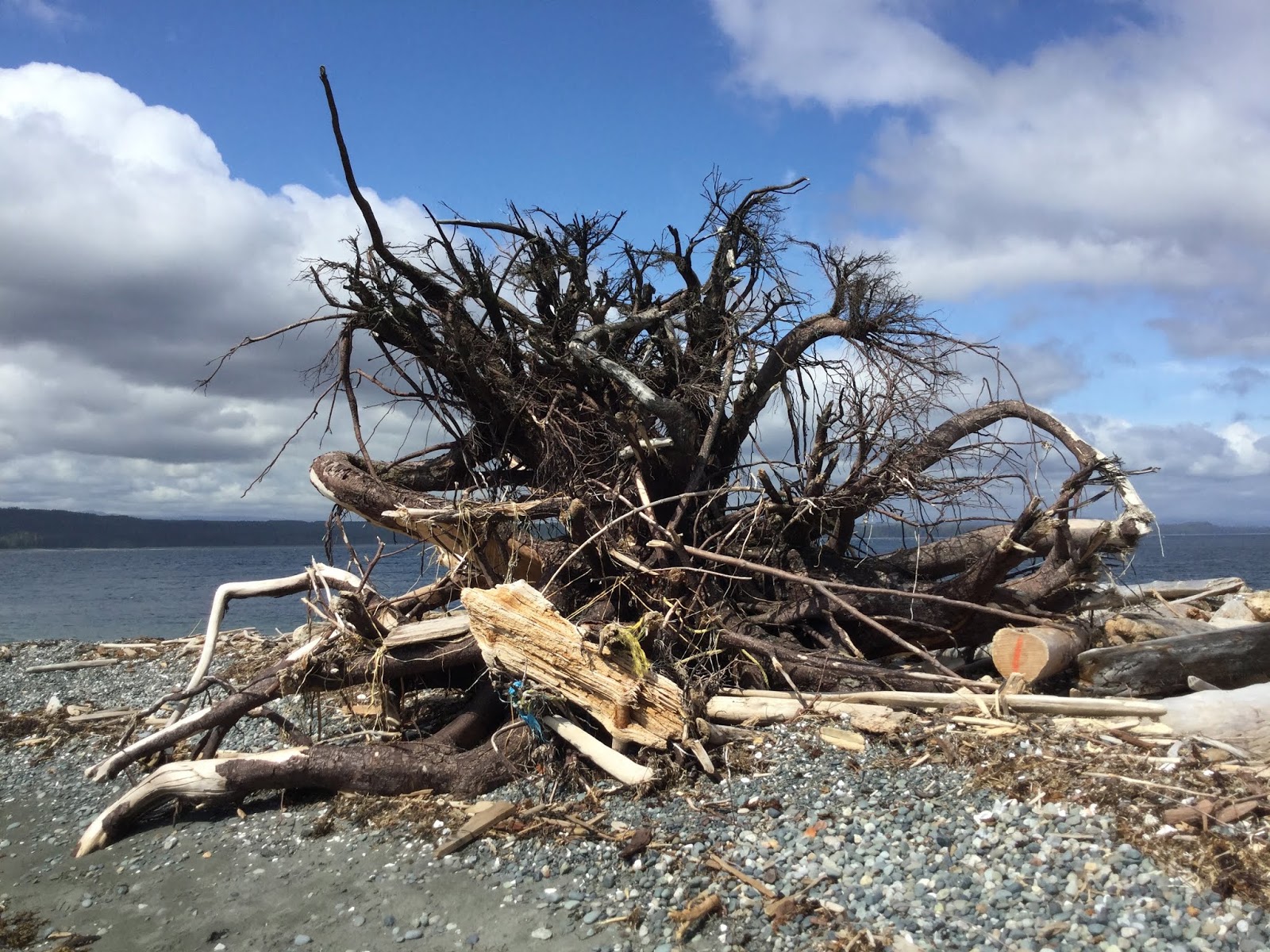
I spent Thanksgiving on Long Island, much larger than Malcolm Island. Another difference concerns beaches. In Westhampton, the beach is sandy, and you see your footprints as you walk, along with the prints of dogs and of birds. On Malcolm Island, it is all rocks, very polished rocks, not so easy to walk on, and certainly no prints of man or dog. In contrast, Malcolm Island has the most wonderful varieties of driftwood, while the beaches of Westhampton display scarcely a stick. (Click on photos to enlarge.)
But as on Malcolm Island, I notice that I am always looking at the beach in front of my feet when I walk, as if I might discover a lovely shell or an interesting rock formation. Again, on Malcolm Island, the beach itself, being so rocky, one seldom comes across a shell that is not broken. But why is it that we stop to gather rocks and shells anyway? On city streets, after all, who bothers examining gum labels, plastic dental picks, or other debris? The former suggest natural processes, from which we humans are removed. The latter is an unattractive reminder of waste and of disregard for the natural world.
I also have to add that I love the solitariness of winter beaches, as in Westhampton. There were a few people out walking, especially with their dogs, but a winter beach does not invite conviviality. It is a place to reflect, again, perhaps on the transience of life as represented by our footprints in the sand, soon to be effaced by the next wave.
The objects on the beaches, on the other hand, represent processes that have been going on from time immemorial and will continue after we are no longer here. The world today is exactly as it was when such objects came into formation, especially in the case of rocks, which testify to the age of the earth. While I was in Westhampton, I was reading Autumn, a volume in Karl Ove Knausgaard's new literary quartet. I came across a passage that speaks to this special character of rocks and shells. Knausgaard, writing of frogs, has this to say:
"Like all other amphibians there was something primordial about [frogs], they came from a different time than us, from a world that was simpler, for even trees and plants were more primitive then, and that they were still here, unlike nearly all other creatures that had existed at that time, was due to the fact that their way of life was so resilient and unaffected by all the changes the surrounding world had undergone. To them the world now must appear the exact same as the world then: they saw, did, thought and felt the same, and this changelessness, in which neither the past nor the future existed, was in principle no different from that possessed by more recent species, like squirrels or badgers, except that it had lasted immeasurably longer."
![]() | |
| Man and dog were here |
But as on Malcolm Island, I notice that I am always looking at the beach in front of my feet when I walk, as if I might discover a lovely shell or an interesting rock formation. Again, on Malcolm Island, the beach itself, being so rocky, one seldom comes across a shell that is not broken. But why is it that we stop to gather rocks and shells anyway? On city streets, after all, who bothers examining gum labels, plastic dental picks, or other debris? The former suggest natural processes, from which we humans are removed. The latter is an unattractive reminder of waste and of disregard for the natural world.
I also have to add that I love the solitariness of winter beaches, as in Westhampton. There were a few people out walking, especially with their dogs, but a winter beach does not invite conviviality. It is a place to reflect, again, perhaps on the transience of life as represented by our footprints in the sand, soon to be effaced by the next wave.
The objects on the beaches, on the other hand, represent processes that have been going on from time immemorial and will continue after we are no longer here. The world today is exactly as it was when such objects came into formation, especially in the case of rocks, which testify to the age of the earth. While I was in Westhampton, I was reading Autumn, a volume in Karl Ove Knausgaard's new literary quartet. I came across a passage that speaks to this special character of rocks and shells. Knausgaard, writing of frogs, has this to say:
"Like all other amphibians there was something primordial about [frogs], they came from a different time than us, from a world that was simpler, for even trees and plants were more primitive then, and that they were still here, unlike nearly all other creatures that had existed at that time, was due to the fact that their way of life was so resilient and unaffected by all the changes the surrounding world had undergone. To them the world now must appear the exact same as the world then: they saw, did, thought and felt the same, and this changelessness, in which neither the past nor the future existed, was in principle no different from that possessed by more recent species, like squirrels or badgers, except that it had lasted immeasurably longer."
Thursday, October 11, 2018
Two more Sointula 2018 memories
I am posting here two pictures from my summer stay. One of them is of my friend Heather and myself, posing with a copy of the London Review of Books, a picture of us that was taken in connection with a competition held by the LRB showing people reading the publication. The other picture is of myself at the Salmon Days parade. More next year! (Although I may post on utopias in the coming months.)
Wednesday, September 12, 2018
Sointula folks
This will be the last post of photos from my 2018 Sointula summer. Some of these were taken on my outing with Milan and Leo to Lizard Point, a great hike to the north beach of Malcolm island. Others were from the "Virgo party," which took place the last day of August at Bere Point, an annual event for the many Virgos on the island, including myself. As always, click to enlarge.
BERE POINT
VIRGO PARTY
BERE POINT
VIRGO PARTY
![]() |
| Max and Eleonore |
![]() |
| Candy |
![]() |
| Shirley |
![]() | ||
| Robin and Janine |
![]() |
| Jan and daughter |
![]() |
| Tracey |
![]() |
| Craig and Fabiola |
![]() | |
| Jody
|
Wednesday, September 5, 2018
Final mementos
I am back in New York since Monday, arriving at JFK to encounter temperatures of 91 degrees. When I left Vancouver the night before it had been 70 degrees. Okay, enough of that. This is the first of a couple of posts concerning my final weeks. The next one will concern people, but here the post is devoted to mushrooms espied on my final Thursday morning hike with the ladies, this time to Mitchell Bay, where we crossed the property of the Weavers, marched through a forest in a vast state of decomposition, and made our way down to the North beach. Very small mushrooms, so you had to keep your eyes open.
Sunday, August 26, 2018
The Art Shed
I want to mention the Art Shed, which is the artist residency program in Sointula. Two summers ago the artists included Lindsay Montgomery and Femke de Vries. Both returned this summer. Lindsay, a Canadian, does beautiful ceramics that re-imagine medieval manuscript illustration. Femke, who is from Amsterdam, works on theoretical projects concerning clothing and fashion. Dictionary Dressings is one of her books. The picture above and one of those below of Lindsay's works were taken at the Art Shed itself this summer.
![]() | ||||
| Femke de Vries |
Wednesday, August 22, 2018
Summer is short in Sointula
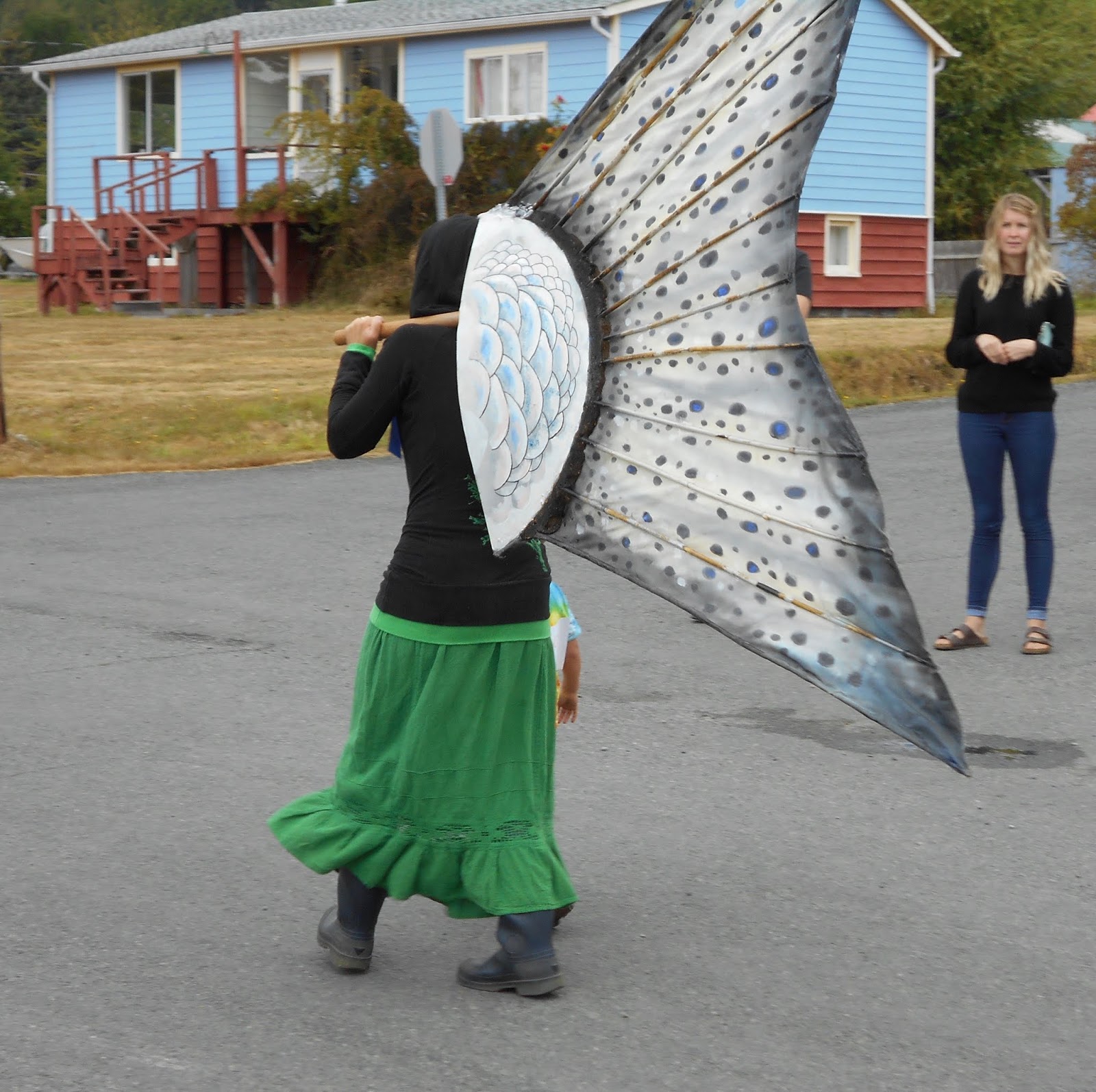
Salmon Days have come an gone, an event that brings quite a few people to the island, for the parade and also for the barbecue that takes place on the baseball field. The parade is headed by so-called Mounties in full regalia. Several people prepared floats, including a troupe of kids wearing various parts of the salmon. Janine turned out with one of her small dogs.
After Salmon Days, there was another week of Sointula summer -- temperatures in the low 70s by afternoon) -- but in the last few days, for the first time since I have been coming here, the island also has experienced the effects of the fires raging on the mainland. At first the smoke was restricted to the lower part of Vancouver Island, but in the last two days, combined with the morning fog, the sun has looked rather end-of-the-worldly.
![]() |
| Janine |
![]() |
| Janine's pooch |
After Salmon Days, there was another week of Sointula summer -- temperatures in the low 70s by afternoon) -- but in the last few days, for the first time since I have been coming here, the island also has experienced the effects of the fires raging on the mainland. At first the smoke was restricted to the lower part of Vancouver Island, but in the last two days, combined with the morning fog, the sun has looked rather end-of-the-worldly.
Subscribe to:
Posts (Atom)