Thursday, August 9, 2018

Whale watching in Mitchell Bay

People out here are always telling me about the whales they see, even outside their house. It doesn't happen when I am around.  I have bad karma when it comes to sighting them. True, I have been on a couple of whale-watching outings, which are led by people who carry radios and communicate with other people carrying radios and literally go hunting the whales (figuratively speaking). On those trips, I have indeed seen a couple of whales in the distance, usually at the moment when that all that is visible is the tail.

Thursday mornings in Sointula a number of ladies do a hike, and today we went to Mitchell Bay. As soon as we got out of the car at the marina, people were saying that a whale had just passed. We walked along the beach road, but it had gone on. One person who lives in Mitchell Bay, right on the water and who is able to see whales out of her window many days of the year, said that whales sometimes turn around. Not today. As I said, I bring my whale karma with me.

In any case, it was a lovely day, a lovely walk. Herewith a few beach pictures. Driftwood and rocks are today's theme. And here is a link to Mitchell Bay, which includes a map that can be expanded. As always with my pictures, click to enlarge.


Many uses for driftwood here.


Thursday, August 2, 2018

Literary utopias

Celesteville, the perfect utopia
A recent issue of The New Yorker has a review of The Last Utopians: Four Late Nineteenth-Century Visionaries and Their Legacy by Michael Robertson (Princeton UP). I write "literary" utopias in the title of the post, for the book does not concern utopias that actually came into existence, such as Sointula itself. With an important exception -- Thomas More's Utopia (1516) -- utopia was until the 19th century mainly "conceptual," with lots of blueprints. One sees the beginnings of such blueprints in the Renaissance, but it was not until the 19th century that utopian communities, with real people living and working in them, that they moved from the conceptual realm and took up life throughout the American and indeed Canadian lands. W.H. comes close to pinpointing the problem with utopias. According to Adam Gopnik in his review of Robertson's book, Auden held that “a utopia ...  was dangerously shaped by a false idea of common good, which meant pretending that everyone wanted the same thing.”

Besides the blueprints and theses, several writers have written novels portraying life in a place where the utopian good reigns. Of the four that Robertson treats, I have read Edward Bellamy's Looking Backward (1888) and William Morris's News from Nowhere (1890), both very influential in their time. Both novels are set in the future, but the novels reflect the different attitudes of the authors toward industrialization.  Bellamy, an American, was writing at a moment when the United States was revving up to become a world power thanks to its growing industrial capacity. In his novel, the main character goes to sleep at the end of the 19th century and awakens in the year 2000 to find the U.S. transformed into a socialist utopia through the power of industry. Morris, an Englishman, wrote his novel in response to Bellamy and set his future utopia in an agrarian England restored, as Gopnik writes, to “pastoral purity” lacking all signs of industry and commerce. Gopnik sums up the different results as follows: “Bellamy was chiefly prescient about Amazon Prime,” while “Morris wanted social justice in the form of flowered wallpaper.”

William Morris's Arts and Crafts wallpaper
Gopnik notes two aspects of Thomas More's formula that Bellamy and Morris adopted: the importance of artisanal works over mental work; and a sexual egalitarianism at odds with the the habits and inclinations of the writers themselves. As for the first, Gopnik adds: “thinking people are told by a thinking person to stop thinking.” One thing he neglects to add is that the account is by a first-person narrator who has been there and come back to tell the tale.

Here are some features of Bellamy's new society: The nation itself now owns, manages, and distributes all capital and all goods and services. The citizens, men and women, are organized on the principle of universal military service into an industrial army that produces all of the nation's goods. Every citizen begins working at twenty-one and retires at forty-five. It is a cradle-to-grave social system, without any need for money. Instead, each year the nation's wealth is divided evenly, and each citizen is issued a credit card for his share to purchase the goods and services he desires. There are no political parties and no corrupt public officials. Not to forget that women are liberated from housework because of technical improvements, not really spelled out. There are also drugs for sleeping.

This perfect society has come into being without bloodshed, simply by abolishing private property. Bellamy appears not to imagine that there would be conflicts of interest interfering with the common good. He gives no attention to the possibility of bureaucratic stupidity or malfunctioning. He simply believes that if you remove private property, everything will be solved. As Gopnik points out, however, it is an exceedingly regimented society, ultimately brutal: "What is chilling in Bellamy is how much of the totalitarian imagination is already in place in his work, and how alluring it can seem."

Morris was a real Marxist, but one reacting against Bellamy's technological socialism. Though News from Nowhere takes place 200 years in the future, this is an idealized Middle Ages, in which people travel by boats, which they row themselves, up a very clean Thames. There is no industrial army: People make what they need for themselves and for others. Englishmen and women of the future are astounded when our time traveler asks to pay for something. There are no schools and no encouragement of reading in children, who instead learn by doing.

Just for fun, let me mention some of things from Thomas More's utopia that have come to be:

Before getting married, you are allowed to see your partner naked. Divorce is allowed for a married couple who "do not well agree." You are under constant surveillance. Utopians eat in public. This is really part of the focus on eliminating the private sphere — but it basically means people eat out. All the time. Euthanasia is supported and even encouraged.

Friday, July 27, 2018

Echo Bay

Today we made an excursion to Echo Bay, which is in the Broughton Archipelago. As in 2016, Jim Macdougall took us out on his boat. We set out at 7 a.m., in heavy fog, from the tip of Malcolm Island. Echo Bay can be seen in the map above, on Gilford Island. We made a stop at Billy Proctor's Museum, which contains found objects from a lifetime of collecting, often from the beaches of this part of the world.  Herewith some pictures. Click to enlarge.

Femke, Goethe Girl, Heather, Jim

Islands in the fog

Early birds catch the fish
Scenes from Billy's Museum:


At the marina at Pierre's, I came across someone who had just bagged a big piece of cod was preparing it for dinner.


Lauren

Sunday, July 22, 2018

Malcolm Point hike

Yesterday was a wonderful hike with two Sointula friends, Milan and Lauren. Wonderful, but exhausting. Last evening when I downloaded my photos, I was obviously so tired that I posted my report of the trek on my Goethe blog. If you want to see some photos of our hike, go there. In the meantime, one photo from that expedition.

Thursday, July 19, 2018

Sointula skies

The sky here is so beautiful, constantly changing. Here are a couple scenes from today. (Click to enlarge.) The first was taken this morning. The black spots against the mass of clouds were eagles, which my iPod obviously could not capture. What amazed me later when I looked at the photo, however, were the clouds.

The second picture was taken just a few minutes ago, 9:30 p.m.


Friday, July 6, 2018

Settling in

Yesterday morning there were deer in the back yard again. In the afternoon I saw a deer jump a fence, one about five feet high. To protect your garden, I hear the fence must be at least six feet. There is a big influx of deer this summer. Later in the day the Jensons gave me a huge bag of crabs. Heather and I spent two hours this morning cracking the shells. By the end we had a couple of pounds of crab. Tonight was the first installment on our efforts: "crab melt" on brioches. Oh, gosh, it looks like I will be eating a lot of fresh fish this summer. As always, click on photo to enlarge.


Thursday, July 5, 2018

Back in Sointula

Here I am again, ensconced in my cottage.  I flew via Toronto to Nanaimo, where I rented a car and drove north. Stopped on the way at Fanny Bay and picked up a bucket of oysters, along with some halibut burgers and crab cakes. It was 98 degrees when I left New York; here it is 60 degrees in the morning, rising to the low 70s in the afternoon. Morning I work indoors on my novel; in the afternoon I sit out on the deck (see picture below, a painting made last summer by Tyler) and read. My summer reading is mostly Hermann Hesse, as I have a review to write by November of the English-language translation of a recent biography. Like many Germanists, I have read Hesse, but not in depth, and have also taught him. Demian was always a good choice for undergraduates. Now I am going back to the early works. Peter Camenzind: what a wonderful novel! It is wonderfully quiet here, although interrupted occasionally by power saws cutting firewood for the winter. Long walks, conversations with old friends. More news to follow.


Saturday, June 30, 2018

Utopias an infinitum

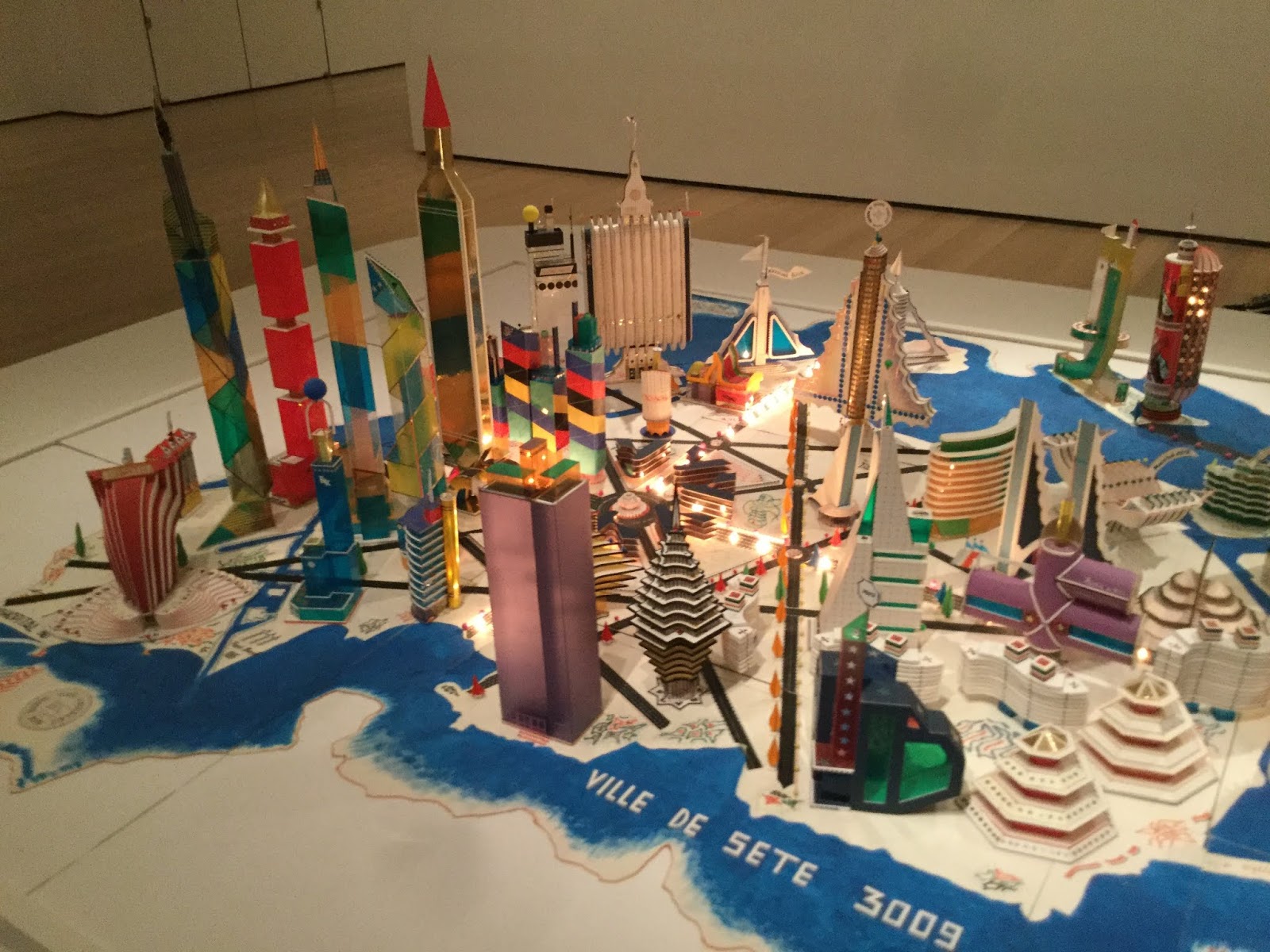
I am packing my bag today, as I fly tomorrow to British Columbia for my summer sojourn in Sointula, the community that inspired my reflections on utopia. Below are some pictures of works by the Zaire artist Body Isek Kigelez (1948-2015) that are currently on view in the exhibit City Dreams at the Museum of Modern Art in New York. These intricately constructed sculptures of miniature buildings and cityscapes suggest harmonious cities of the future. The works are created from plastic, soda cans, bottle caps, commercial packaging, colored paper -- in other words, the "found objects" or detritus of our contemporary wasteful environment. The artist was clearly attuned to international affairs and "global" issues. (Click on pictures to enlarge.)


Note the Canadian flag 


Not many hours later I was walking along the Hudson River greenway and was struck by the resemblance of his tiny sculptures to a contemporary Manhattan sight. Of course, it could be any city in the world.

Thursday, June 7, 2018

Return to Sointula (soon)

It's June, which means I will be back in my cottage in Sointula in a month. I will be blogging and posting photos and thinking about utopia. In the meantime, I add here some pictures from last summer. As always, click on image to enlarge.

In Wren's studio

The Art Shed

Puk's bike

Femke's project

On the ferry to Sointula

Canada Post

Swimming at Bere Point
At Cape Scott

For gas and other needs in Sointula

Wednesday, February 7, 2018

Catching up

This blog is about Sointula, and since I am not in Sointula right now and won't be back there until July it might be thought that I would not be posting. Actually, I wanted to use these months when I am not on the island to reflect on the subject of utopia (see my earlier post on this subject), which was what brought me to Sointula in the first place. I had ordered a copy of Andrew Scott's book, Promise of Paradise, and was eager to write about it. And then Google Blogger, which carries this blog, began presenting technical difficulties when it comes to uploading images to the blog. Beginning November 21, I was unable to upload any photos I had taken in Sointula. And what is a blog without pictures? Moreover, in trying to figure out how to upload pictures, I accidentally deleted all the images that were in the posts. As of this date, February 7, Google has solved the problem, and I have gone back to the old posts and reinserted the images.

Today I would like to upload some pictures from last summer. I will add captions. The last picture is of Hillel Wright who sadly passed away during the summer. He and I were biking companions and indeed all around friends this past summer. We had political differences, but he was a great raconteur.

Hidden car 1

Hidden car 2

Puk and Myrna

Croquet at the Jensens

With Freda in Alert Bay

My work station

Hillel Wright performing

Wednesday, November 15, 2017

Utopian visions

Until I return to my summer idyll in July, I will only be posting occasionally, when something "utopic" strikes me. Yesterday I was at the Metropolitan Museum and came across a painter and a work that reminded me of the communal ethos that forms the basis of the utopian ideal. The painter is a Frenchman, Pierre Puvis de Chavannes (1824-1898). There is not much I can say about him now; I have to get used to these paintings. Emile Zola is supposed to have described his work as "an art made of reason, passion, and will." I see the reason part. People who plan utopian communities believe that people will necessarily and rationally work for the greater good. Utopias tend to efface the individual element, and the figures in this artist's work are certainly not recognizable people.

Although many of his paintings suggest an idealized community, the painting that particularly struck me was The River, the component parts of which portray the communal work and activities of a utopia. It is not surprising that the work of women and that of men are differently conceived, as in the two details below. (Click on images to enlarge.)


 And here is the complete canvas.


I particularly liked the reflections in the water of the bathers and of the vegetation.